Loading page
Financial Guide
The 50/30/20 Budgeting Rule: The Complete Guide to Managing Salary and Building Wealth
12 min read

Most personal finance advice fails for the exact same reason strict crash diets fail: it is designed for robots, not human beings.
Traditional budgeting gurus demand that you track every cup of coffee, scrutinize grocery receipts down to the cent, and eliminate every shred of enjoyment from your daily routine. You create a complex 40-row spreadsheet in January, follow it meticulously for three weeks, and abandon it completely by mid-February out of pure decision fatigue.
Meanwhile, money continues to vanish mysteriously between paychecks. You earn a healthy income, yet by the 25th of the month, your checking account dwindles, credit card balances creep upward, and your savings remain frozen.
The breakthrough is realizing that wealth is not built through deprivation. It is built through proportional cash flow architecture.
Popularized by Harvard bankruptcy expert and U.S. Senator Elizabeth Warren and her daughter Amelia Warren Tyagi in their landmark book All Your Worth: The Ultimate Lifetime Money Plan, the 50/30/20 Rule has become the global gold standard for personal budgeting.
Instead of micromanaging hundreds of tiny expenses, the 50/30/20 framework divides your take-home income into three intuitive, broad buckets:
- 50% for Needs (Survival & Non-Negotiables)
- 30% for Wants (Guilt-Free Lifestyle & Joy)
- 20% for Savings & Debt Elimination (Future Financial Freedom)
Let's dissect how this rule works in practice, explore realistic adaptations for expensive metropolitan cities, walk through concrete salary examples, and demonstrate how automating this simple 20% allocation compounds into life-changing long-term wealth.
The 50/30/20 Framework Explained
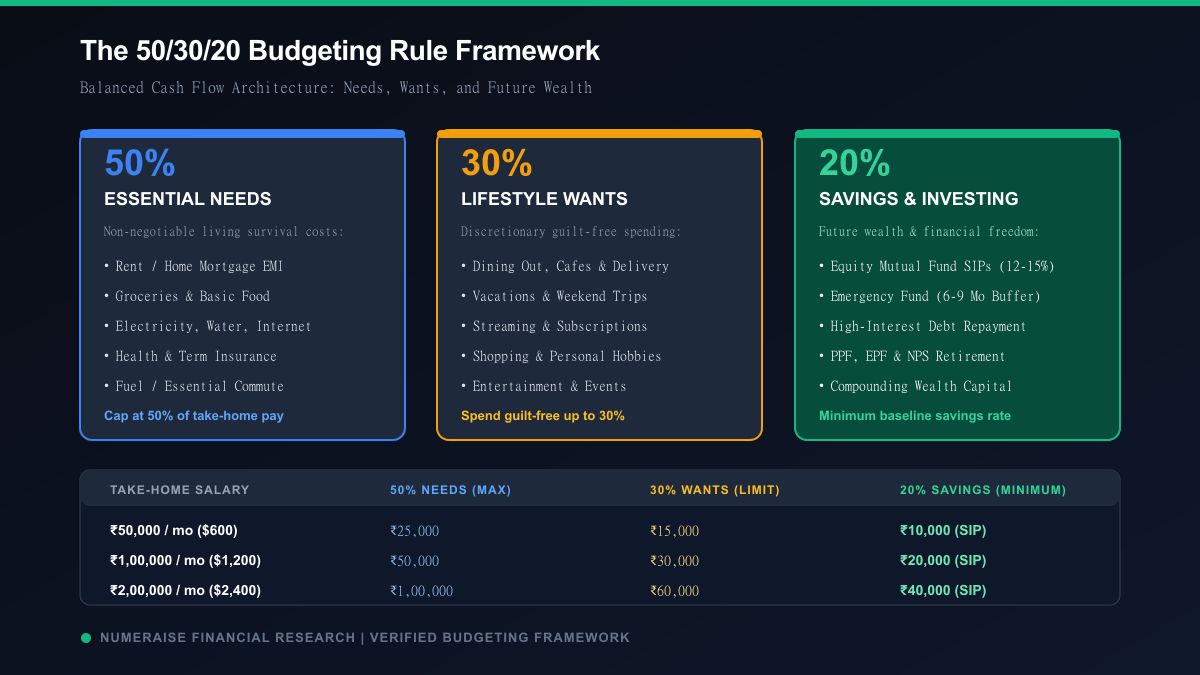
The rule operates strictly on your after-tax, take-home pay—the actual amount deposited into your bank account each month after income tax, provident fund, and statutory deductions are removed.
1. The 50% Bucket: Essential Needs
Needs are expenses you cannot avoid without experiencing severe physical, legal, or financial harm. If you lost your job tomorrow, these are the bills that must still be paid to keep a roof over your head and food on the table.
What Qualifies as a Need:
- Housing: Rent or home loan EMI, property taxes, and society maintenance charges.
- Groceries: Basic, nutritious food and home cooking supplies (not Friday night takeout).
- Basic Utilities: Electricity, water, cooking gas, heating, and home internet.
- Essential Transportation: Public transit passes, commuter train tickets, or basic fuel and insurance for a commuter vehicle.
- Healthcare & Protection: Health insurance premiums, life/term insurance, and recurring prescription medications.
- Minimum Debt Payments: The contractual minimum due on credit cards or personal loans to avoid legal default.
The Golden Test: Can you eliminate or pause this expense for three months without disrupting your basic survival? If the answer is yes, it belongs in the Wants bucket.
2. The 30% Bucket: Guilt-Free Lifestyle Wants
This is the psychological brilliance of the 50/30/20 rule. Rather than preaching austerity, it explicitly earmarks nearly a third of your paycheck for pure lifestyle enjoyment.
When you budget for enjoyment upfront, you eliminate the toxic guilt that usually accompanies spending.
What Qualifies as a Want:
- Dining Out & Socializing: Restaurants, cafes, craft cocktails, and food delivery apps (Swiggy, Zomato, DoorDash).
- Entertainment & Media: Streaming subscriptions (Netflix, Spotify, Prime), cinema tickets, and gaming.
- Travel & Leisure: Weekend getaways, international flights, and festival holidays.
- Shopping & Aesthetics: Fashion upgrades beyond basic clothing, luxury grooming, and home decor.
- Upgraded Transportation: Choosing a luxury SUV or leather-seat trim instead of a functional commuter sedan (see our guide on The 20/4/10 Rule for Car Affordability).
The Rule of the 30% Bucket: As long as your total Wants stay under 30% of your take-home income, you are free to spend that money on whatever brings you happiness.
3. The 20% Bucket: Future Wealth & Debt Freedom
The final 20% is your ticket out of the rat race. This money does not get consumed; it is put to work 24/7 in assets that compound over time.
The Hierarchy of the 20% Bucket:
- Tier 1: High-Interest Debt Elimination: Any credit card debt, payday loans, or consumer durable loans with interest rates above 12% must be eliminated immediately. Paying off a 36% APR credit card is equivalent to earning a guaranteed, risk-free 36% return.
- Tier 2: Emergency Safety Buffer: Building a 3- to 6-month living expense reserve in high-yield savings accounts or liquid mutual funds (see How to Build an Emergency Fund).
- Tier 3: Systematic Wealth Creation: Monthly equity Systematic Investment Plans (SIPs) in diversified index funds and flexi-cap mutual funds targeting 12% to 15% CAGR (see The 15-15-15 Rule in Mutual Funds).
- Tier 4: Long-Term Retirement: Voluntary contributions to EPF, PPF, and National Pension System (NPS).
You can easily calculate your personal 3-bucket allocation using our free Budget Calculator.
Real-World Salary Case Studies
To see the 50/30/20 rule in action, let's examine three typical take-home income levels:
Case Study A: The Early-Career Earner
- Take-Home Salary: ... (₹50,000 / $600 per month)
| Bucket | Allocation % | Monthly Amount | Real-World Application |
|---|---|---|---|
| Needs | 50% | ₹25,000 (...) | Shared apartment rent (₹14k), groceries & utilities (₹7k), transport & insurance (₹4k). |
| Wants | 30% | ₹15,000 (...) | Weekend dining out (₹8k), subscriptions & shopping (₹4k), hobbies & social events (₹3k). |
| Wealth | 20% | ₹10,000 (...) | Diversified Equity SIP (₹7k), Emergency Fund recurring deposit (₹3k). |
Case Study B: The Mid-Level Professional
- Take-Home Salary: ... (₹1,00,000 / $1,200 per month)
| Bucket | Allocation % | Monthly Amount | Real-World Application |
|---|---|---|---|
| Needs | 50% | ₹50,000 (...) | 2BHK rental/EMI (₹30k), groceries & household (₹10k), health/term insurance (₹4k), fuel/utilities (₹6k). |
| Wants | 30% | ₹30,000 (...) | Fine dining & bars (₹12k), electronics/clothing (₹8k), domestic vacation fund (₹10k). |
| Wealth | 20% | ₹20,000 (...) | Nifty 50 Index Fund (₹10k), Flexi-Cap SIP (₹6k), Mid-Cap Fund (₹4k). |
Case Study C: The Senior Tech / Management Earner
- Take-Home Salary: ... (₹2,00,000 / $2,400 per month)
| Bucket | Allocation % | Monthly Amount | Real-World Application |
|---|---|---|---|
| Needs | 50% | ₹1,00,000 (...) | Premium apartment rent or home loan EMI (₹60k), family groceries (₹18k), car maintenance/fuel (₹10k), utilities & school/insurance (₹12k). |
| Wants | 30% | ₹60,000 (...) | Luxury dining (₹20k), international holiday sinking fund (₹25k), personal hobbies & upgrades (₹15k). |
| Wealth | 20% | ₹40,000 (...) | Core Equity Portfolio (₹25k), International Equities (₹5k), NPS Tier-1 (₹5k), PPF (₹5k). |
You can model your exact paycheck breakdown and check net take-home pay using our Paycheck Calculator.
The Reality Check: What if Rent is Too High?
One frequent objection from readers living in tier-1 cities (such as Mumbai, Bengaluru, Delhi NCR, London, or San Francisco) is:
"My rent alone takes up 40% of my paycheck! How am I supposed to fit all my utilities, food, and transport into 50%?"
This is a completely valid critique. If you live in an expensive metropolitan hub, you may need to customize the baseline percentages. Here are two battle-tested variations:
Variation 1: The High-Cost Metro Rule (60/20/20)
- 60% Needs: Accommodates high urban rents and commuter costs.
- 20% Wants: Tightens discretionary lifestyle spending temporarily.
- 20% Savings: Non-negotiable. Never sacrifice your 20% wealth allocation to fund higher living costs.
Variation 2: The FIRE / Aggressive Wealth Rule (50/20/30)
- 50% Needs: Standard living baseline.
- 20% Wants: Controlled, mindful lifestyle consumption.
- 30% Savings: Accelerates early retirement and financial independence by a full decade (see our guide on The FIRE Movement & Early Retirement).
The Multi-Crore Compounding Power of That 20%
Many people underestimate the sheer financial firepower of saving "just 20%." They think, "What difference does ₹10,000 or ₹20,000 a month really make?"
Let's look at the numbers.
If you invest your 20% savings allocation into an Equity Mutual Fund compounding at a historical market average of 12% CAGR, here is what happens over time:
| Monthly 20% Allocation | Total Invested (20 Years) | Portfolio Value at 10 Years | Portfolio Value at 20 Years | Portfolio Value at 25 Years |
|---|---|---|---|---|
| ₹5,000 / month (...) | ₹12.0 Lakhs | ₹11.6 Lakhs | ₹49.9 Lakhs | ₹94.9 Lakhs |
| ₹10,000 / month (...) | ₹24.0 Lakhs | ₹23.2 Lakhs | ₹99.9 Lakhs | ₹1.90 Crores |
| ₹20,000 / month (...) | ₹48.0 Lakhs | ₹46.5 Lakhs | ₹1.99 Crores | ₹3.80 Crores |
| ₹40,000 / month (...) | ₹96.0 Lakhs | ₹92.9 Lakhs | ₹3.99 Crores | ₹7.59 Crores |
Notice that an investor saving ₹20,000 per month out of a ₹1 Lakh salary accumulates nearly ₹2 Crores ($240,000) in 20 years, and ₹3.8 Crores ($457,000) in 25 years!
You did not have to live like a monk or sacrifice weekend dinners. You spent 30% of your earnings every month having fun, while the automated 20% bucket quietly built multi-crore wealth in the background.
Test your own time horizon and return rate on our interactive SIP Calculator and track your total household assets on the Net Worth Calculator.
How to Automate 50/30/20 in 3 Simple Steps
Willpower is an unreliable financial strategy. The secret to effortless budgeting is architectural automation:
Step 1: Open Three Separate Bank Accounts
- Account A (Fixed Expenses / Needs): This is where your salary lands. Rent, EMIs, utility bills, and insurance auto-debits are linked exclusively to this account.
- Account B (Wealth & Investment Machine): Set up automated standing instructions to pull your 20% savings on the 2nd or 3rd day of the month, immediately after payday.
- Account C (Guilt-Free Spending Debit Card): Transfer your 30% Wants allowance here on the 1st of every month. Use this debit card for shopping, dining, and weekend outings. When the balance hits zero, your entertainment spending pauses until next month.
Step 2: Pay Yourself First
Never save what is left over after spending. Spend what is left over after investing. By automating your 20% SIP on the 2nd of the month, you guarantee that your wealth grows before you can even think about spending it.
Step 3: Annual Step-Up Calibration
Whenever you receive an annual salary hike or promotion, avoid the trap of lifestyle inflation. Direct at least 50% of your increment directly into your 20% investment bucket. Learn more about this exponential wealth accelerator in our guide: Step-Up SIP: How Annual Hikes Double Your Wealth.
Frequently Asked Questions (FAQ)
Should gross salary or net take-home salary be used?
The 50/30/20 rule is designed strictly for net take-home salary (the money that actually hits your bank account after taxes and statutory deductions).
Does credit card debt payment count as a Need or Savings?
The contractual minimum payment required to avoid late fees and credit score damage is a Need. Any additional extra payment made to aggressively destroy the principal balance belongs in the 20% Savings & Debt bucket.
What if I cannot save 20% right now?
Start where you are. If you can only save 5% or 10% today, automate that amount immediately. As your income increases or as you eliminate minor recurring expenses, gradually increase your savings rate until you reach the 20% benchmark.
Take Control of Your Financial Freedom
Budgeting is not about limiting your life; it is about allocating your finite resources toward the things that matter most.
- Calculate your 50/30/20 target with our Budget Calculator.
- Automate your 20% investment bucket with an equity SIP on our SIP Calculator.
- Spend your 30% Wants bucket with complete, guilt-free confidence!