Loading page
Financial Guide
The 30/30/3 Rule for Buying a Home: How Much House Can You Really Afford?
12 min read

There is no milestone in adult life celebrated with more fanfare than purchasing your first home. Family members applaud your maturity, friends congratulate you on social media, and society tells you that you have finally arrived:
"Rent is just throwing money away every month! Real estate only goes up. Buy the biggest home the bank will approve you for—your salary will grow into the mortgage payments."
Mortgage lenders and real estate brokers are all too eager to reinforce this narrative. Walk into any major bank today with a gross household income of ... per month (₹2.5 Lakhs / $2,600), and a loan officer will happily pre-approve you for a ... (₹1.50 Crore / $157,000) mortgage on a 30-year repayment schedule.
On paper, the bank's underwriting algorithms say you qualify. But in real life, that single decision often leads directly into the most stressful financial trap in modern society: becoming "House Rich, Cash Poor" (or simply "House Poor").
flowchart TD
    A["Overstretching for Dream Home<br/>(Loan EMI eats 50-60% Take-Home)"] --> B["Depleted Cash Reserves<br/>(Down payment drains emergency fund)"]
    B --> C["Surprise Ownership Costs<br/>(Stamp duty, maintenance, property tax)"]
    C --> D["The House Poor Trap<br/>• Zero surplus for equity SIPs<br/>• Paralyzing job loss anxiety<br/>• 30-year mortgage servitude"]
When your monthly home loan payment consumes 50% to 60% of your take-home pay, your house ceases to be a haven of comfort. It becomes a financial prison. You cannot afford to travel, you eat instant ramen when unexpected medical bills arrive, you stay trapped in toxic workplaces because missing one paycheck means defaulting on the mortgage, and you have zero cash left to invest in high-compounding equity mutual fund SIPs.
To protect homebuyers from financial catastrophe, experienced wealth managers and housing economists developed the 30/30/3 Rule.
Let's examine how this three-part mathematical framework works, uncover the hidden "iceberg" costs of homeownership, and calculate the exact maximum property price your salary can safely handle.
What is the 30/30/3 Rule?
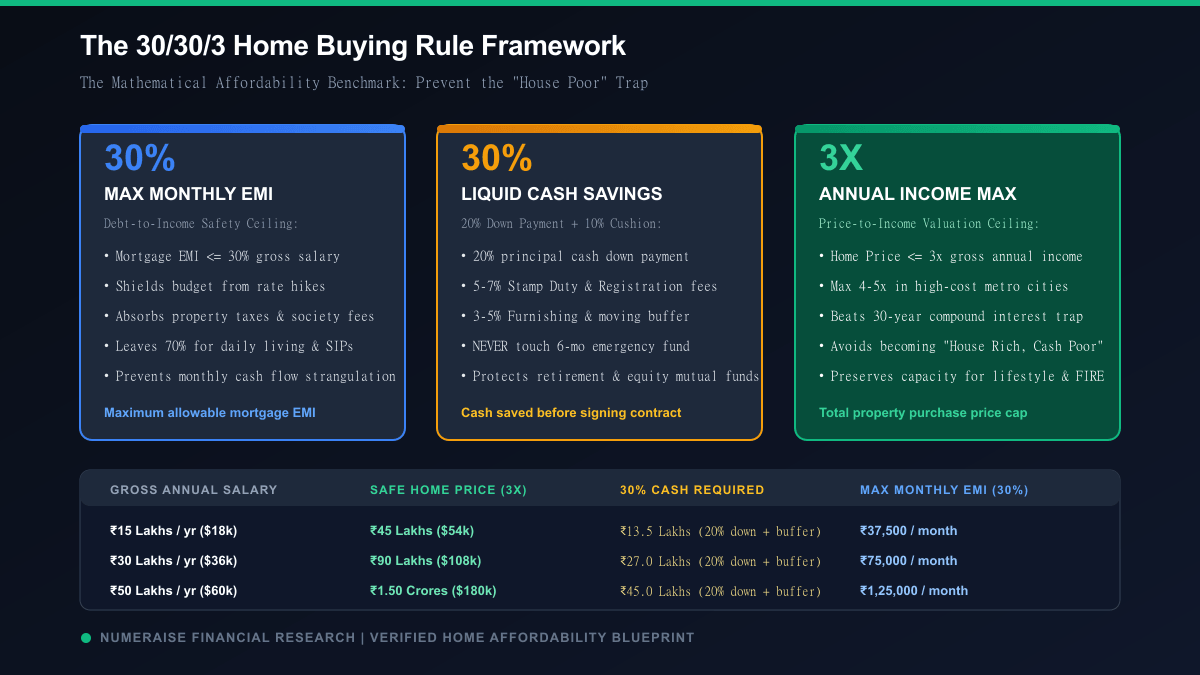
The 30/30/3 rule is an intuitive, tripartite benchmark that establishes strict safety boundaries for your mortgage payments, down payment reserves, and total property valuation:
flowchart LR
    P1["Pillar 1: 30% Max EMI<br/>• Debt-to-income ceiling<br/>• Shields budget from rate hikes"] --> P2["Pillar 2: 30% Liquid Cash<br/>• 20% down payment<br/>• 10% closing & buffer"]
    P2 --> P3["Pillar 3: 3X Annual Income<br/>• Valuation ceiling<br/>• Prevents debt leverage trap"]
Pillar 1: Monthly Mortgage EMI ≤ 30% of Gross Monthly Income
Your total monthly home loan payment (principal + interest) must not exceed 30% of your gross (pre-tax) monthly income.
- If your household earns ... (₹1.50 Lakhs / $1,570) gross per month, your absolute maximum loan EMI is ... (₹45,000 / month).
- If your household earns ... (₹3.0 Lakhs / $3,150) gross per month, your loan EMI ceiling is ... (₹90,000 / month).
- Why this matters: Capping your mortgage at 30% guarantees that you have 70% of your paycheck remaining to cover income taxes, household groceries, children's education, health insurance premiums, utility bills, and automated wealth investments. Furthermore, it provides an elastic buffer if central banks hike benchmark interest rates by 100 to 200 basis points.
Pillar 2: 30% of Property Value in Liquid Cash Savings
Before signing an agreement to sell, you must have accumulated at least 30% of the property's total market value in liquid cash or short-term fixed deposits.
- 20% for the Actual Down Payment: Putting down 20% cash secures the lowest interest rate tiers from banks and prevents private mortgage insurance penalties.
- 10% for the "Hidden Closing Costs & Buffer": Real estate transactions carry massive statutory and frictional costs (stamp duty, registration charges, brokerage, loan processing fees, utility connection deposits, and basic interior fit-outs).
- The Golden Rule of Liquidity: This 30% cash hoard must be saved over and above your untouched 6-month emergency reserve. You must never liquidate your retirement accounts (EPF, 401k, NPS) or your long-term equity SIP portfolio to buy a primary residence.
Pillar 3: Total Purchase Price ≤ 3x Gross Annual Household Income
The total purchase price of the home should ideally not exceed 3 times your gross annual household income (or up to 4x–5x in ultra-high-cost tier-1 metropolitan cities like Mumbai, Bengaluru, London, or New York).
- If your household earns ... (₹20 Lakhs / $21,000) per year, your target home price is ... (₹60 Lakhs) (or max ... in a metro).
- If your household earns ... (₹40 Lakhs / $42,000) per year, your target home price is ... (₹1.20 Crores) (or max ... in a metro).
- Why this matters: When home prices exceed 5x to 7x annual earnings, the amortization math turns predatory. You end up paying the bank twice the original cost of the house in interest alone over a 25 to 30-year span.
Test your specific numbers on our free Home Loan EMI Calculator and Stamp Duty Calculator.
The Hidden Costs Iceberg: Why 20% Down Payment is Never Enough
The single most common mistake first-time homebuyers make is assuming that saving a 20% down payment is sufficient to complete the purchase.
In reality, the purchase price agreed with the builder or seller is merely the tip of the financial iceberg:

The Hidden Closing Costs on a ... (₹1.0 Crore / $105,000) Home:
| Expense Category | Typical Percentage | Actual Cash Outflow | Description / Purpose |
|---|---|---|---|
| Agreement Base Price | 100.0% | ... | Agreed cost of the flat/house |
| 20% Mandatory Down Payment | 20.0% | ... | Borrower's equity contribution for the loan |
| Stamp Duty & Registration | 6.0% – 8.0% | ... | Mandatory state government statutory duty |
| GST (Under-Construction Only) | 5.0% (if applicable) | ... | Central/State tax on under-construction flats |
| Brokerage / Real Estate Agent Fee | 1.0% – 2.0% | ... | Commission paid to property consultant |
| Bank Loan Processing & Legal Fees | 0.25% – 0.5% | ... | Valuation, title check, and admin fees |
| Society Advance Maintenance / Sinking Fund | Fixed | ... | 1–2 years advance maintenance deposit |
| Essential Interiors, Paint & Modular Kitchen | 8.0% – 12.0% | ... | Wardrobes, kitchen, basic lights & appliances |
| Total Real Upfront Cash Required | ~35% – 40% | ... | Total liquid cash required on Day 1! |
[!WARNING] On a ₹1.0 Crore property, you do not need ₹20 Lakhs. You need at least ₹30 to ₹35 Lakhs in liquid cash before you can comfortably turn the key in the front door without incurring high-interest personal loans or maxing out credit cards for basic furniture.
Case Study: Can Rohan & Priya Afford a ... (₹1.5 Crore) Apartment?
Let's test the 30/30/3 rule in a real-world scenario.
Meet Rohan (32) and Priya (30), senior IT consultants working in Bengaluru. Their combined gross salary is ... per month (₹36 Lakhs / $38,000 annually). After taxes and standard deductions, their combined monthly take-home pay is approximately ....
They have fallen in love with a spacious 3BHK flat listed at ... (₹1.50 Crores). They have accumulated ... (₹35 Lakhs) in total savings.
The Bank's Pitch:
- Loan Amount: ... (₹1.20 Crores / 80% LTV)
- Interest Rate: 8.75%
- Loan Tenure: 25 Years (300 Months)
- Monthly EMI: ... per month
The bank loan officer assures them: "Your take-home is ₹2,25,000. An EMI of ₹98,725 leaves you with ₹1,26,000 every month. You easily qualify!"
What the 30/30/3 Rule Reveals:
Test 1: The 30% EMI Limit
- 30% of Rohan & Priya's gross monthly income (...) is ....
- Actual EMI: ....
- Add Society Maintenance (.../mo) and Property Tax (.../mo amortized): Total Housing Outflow = ... per month.
- Verdict: FAILED. Housing eats 47.4% of their take-home paycheck, leaving their monthly cash flow dangerously constrained.
Test 2: The 30% Liquid Cash Requirement
- 30% of ... is ... (₹45 Lakhs).
- Rohan & Priya only have ... (₹35 Lakhs).
- If they pay 20% down (...) plus stamp duty/registration (...), they will deplete 100% of their savings and still be short by ₹5 Lakhs for basic interior work.
- They will enter their new home with zero emergency buffer.
- Verdict: FAILED.
Test 3: The 3x Annual Income Multiplier
- Target Home Price: 3x their annual gross income ($3 \times ₹36\text{ Lakhs} = \mathbf{₹1.08\text{ Crores}}$).
- In a metro like Bengaluru, stretching to 3.5x gives an upper ceiling of ... (₹1.26 Crores).
- The ₹1.50 Crore property is 4.17x their annual income.
- Verdict: FAILED.
What CAN Rohan & Priya Safely Afford?
Under the 30/30/3 framework, Rohan & Priya should target a home priced between ... and ... (₹1.05 to ₹1.20 Crores):
- 20% Down Payment: ... (₹22 Lakhs)
- Stamp Duty & Closing: ... (₹8 Lakhs)
- Total Cash Outflow: ... (leaves ₹5 Lakhs untouched in their emergency fund!)
- Loan Amount: ... (₹88 Lakhs at 8.75% for 20 years)
- Monthly EMI: ... (well within their 30% limit of ₹90,000!).
The Master Affordability Matrix Across Income Tiers
How much house can you afford based on your household earnings? Here is the complete breakdown adhering to the 30/30/3 framework (assuming 20-year loans at 8.75% interest):
| Annual Gross Income | Gross Monthly Pay | Safe Home Price (3x) | Metro Upper Cap (4x) | 30% Liquid Cash Needed | Safe 30% Max Monthly EMI | 20-Yr Total Interest Paid (Safe) |
|---|---|---|---|---|---|---|
| ... (₹12L / $13k) | ... | ... | ... | ... | ... / mo | ... |
| ... (₹20L / $21k) | ... | ... | ... | ... | ... / mo | ... |
| ... (₹30L / $32k) | ... | ... | ... | ... | ... / mo | ... |
| ... (₹50L / $53k) | ... | ... | ... | ... | ... / mo | ... |
| ... (₹75L / $79k) | ... | ... | ... | ... | ... / mo | ... |
| ... (₹1.0Cr / $105k) | ... | ... | ... | ... | ... / mo | ... |
The Compounding Opportunity Cost: Stretched Home vs. Sensible Home + SIP
What is the true cost of buying more house than you need?
It is not just the extra money paid to the builder. It is the enormous compounding opportunity cost of what that monthly surplus would have become if invested into a diversified equity mutual fund earning 12% CAGR.
Let's compare two buyers earning ... per year (₹30 Lakhs):
- Buyer A (The Overstretched McMansion): Buys a ₹1.50 Crore home. Down payment drains all savings. Takes a ₹1.20 Crore loan for 20 years at 8.75%. Monthly EMI = .... Surplus cash to invest = ₹0.
- Buyer B (The 30/30/3 Disciplined Buyer): Buys a comfortable, high-quality ₹95 Lakh home. Puts down 20% (...). Takes a ₹76 Lakh loan for 20 years at 8.75%. Monthly EMI = ....
- The Difference: Buyer B saves ... per month compared to Buyer A, and automatically routes that exact surplus into an Equity Mutual Fund SIP compounding at 12% CAGR.
The 20-Year Wealth Outcome:
| Year / Milestone | Buyer A (Stretched Home) | Buyer B (30/30/3 Home) | Buyer B's SIP Wealth (12% CAGR) | Buyer B Total Net Worth |
|---|---|---|---|---|
| Year 5 | ₹1.50 Cr Home (equity ~₹45L) | ₹95L Home (equity ~₹28L) | ... (₹32 Lakhs) | ₹60 Lakhs |
| Year 10 | ₹1.50 Cr Home (equity ~₹85L) | ₹95L Home (equity ~₹54L) | ... (₹89.4 Lakhs) | ₹1.43 Crores |
| Year 15 | ₹1.50 Cr Home (equity ~₹1.35Cr) | ₹95L Home (equity ~₹85L) | ... (₹1.94 Crores) | ₹2.79 Crores |
| Year 20 (Mortgage Paid Off) | ₹1.50 Cr Home (Zero Cash) | ₹95L Home (Zero Debt) | ... (₹3.88 Crores Liquid!) | ₹4.83 Crores Total Wealth! |
[!TIP] The Multi-Crore Revelation: At the end of 20 years, Buyer A owns a paid-off house and has zero liquid investments.
Buyer B owns a paid-off house PLUS nearly ... (₹4 Crores / $400,000) in cold, liquid stock market wealth!
By refusing to overstretch on square footage in their 30s, Buyer B achieved complete financial independence in their 50s.
The 30-Year vs. 15-Year Mortgage Trap
When buyers find out that their monthly income cannot comfortably support the EMI for their dream house, loan agents always suggest the same remedy: "Let's stretch the loan from 15 or 20 years to 30 years! It will make the EMI fit your monthly budget."
Beware. The 30-year mortgage is an interest-generating machine for commercial banks:
xychart-beta
    title "Total Interest Paid as % of Original Loan (8.75% Interest Rate)"
    x-axis ["10-Year Loan", "15-Year Loan", "20-Year Loan", "25-Year Loan", "30-Year Loan"]
    y-axis "Interest as % of Loan" 0 --> 190
    bar [50, 79, 111, 145, 182]
The Math on a ... (₹80 Lakh) Loan at 8.75%:
- 15-Year Tenure:
- Monthly EMI: ...
- Total Interest Paid: ... (₹63.9 Lakhs)
- 20-Year Tenure:
- Monthly EMI: ...
- Total Interest Paid: ... (₹89.65 Lakhs)
- 30-Year Tenure:
- Monthly EMI: ...
- Total Interest Paid: ... (₹1.46 Crores)!
[!CAUTION] Stretching your loan from 20 years to 30 years reduces your monthly EMI by only 11% (a measly ₹7,800/mo), but increases your total interest paid to the bank by an astonishing ... (₹56.8 Lakhs)!
On a 30-year loan at 8.75%, you pay 1.82 times the original loan amount in interest alone.
If you must take a 20 or 25-year loan to start, make it your top priority to execute small annual prepayments. Making just one extra EMI payment every year or increasing your EMI by 5% annually slashes a 20-year loan down to barely 12 years. Model this on our Home Loan Prepayment Calculator.
Frequently Asked Questions (FAQ)
What if I live in Mumbai, London, or New York where homes cost 8x to 10x average income?
In tier-1 global megacities, real estate prices are notoriously decoupled from local median wages. If you live in an expensive metropolitan hub, you have three sensible options:
- Stretch the Price Multiplier to 4x–5x Max: Only do this if your job security is rock-solid, you have dual tech/corporate incomes, zero other debts, and a 12-month emergency fund.
- Rent and Invest the Difference: In many global megacities, the rental yield is barely 2% to 3%, while home loans cost 8.5%+. Renting the home you want for a fraction of the EMI and investing the massive cash difference into an equity SIP is mathematically superior. Compare scenarios on our Rent vs Buy Calculator.
- Buy in the Suburbs / Tier-2 Satellite Towns: Commute slightly longer or leverage hybrid remote work to purchase a property strictly within the 30/30/3 boundary.
Should I liquidate my EPF, 401(k), or long-term mutual funds to make the 20% down payment?
Never. Raiding your retirement corpus to buy residential real estate destroys decades of tax-advantaged compound interest. Real estate is an illiquid, concentrated asset with high holding costs. If you lose your job and cannot pay property taxes or maintenance, you cannot sell one bedroom of your flat to buy groceries. Keep your retirement capital protected.
Does the 30% EMI limit apply to gross or net take-home salary?
The traditional rule uses gross (pre-tax) income. However, for families with significant recurring obligations (such as school fees or medical treatments), conservative financial planners recommend applying the 30% ceiling to net (take-home) salary for a bulletproof financial margin.
What if interest rates drop after I buy?
If central banks enter an easing cycle and mortgage rates decline by 50 to 100 basis points, you have two options:
- Reduce Your Loan Tenure: Keep your monthly EMI payment the same while shortening your loan duration. This saves lakhs in compound interest.
- Refinance: Transfer your loan balance to another lender offering a lower benchmark rate.
Plan Your Home Purchase with Precision
Before you visit builder sales offices or sign mortgage agreements, run your exact financial numbers on Numeraise's suite of free financial tools:
- Home Loan EMI Calculator: Calculate your monthly payment, principal-interest amortization split, and total loan cost.
- Home Loan Prepayment Calculator: Discover how small annual principal prepayments can shave 7 to 10 years off your mortgage.
- Stamp Duty Calculator: Calculate exact state registration and closing charges upfront.
- Rent vs Buy Calculator: Determine whether buying or renting makes superior mathematical sense in your city.
- SIP Calculator: Calculate how much wealth you will accumulate by saving your housing down payment in equity mutual funds.