Loading page
Financial Guide
PPF vs. Mutual Fund SIP vs. NPS: Which Wealth Machine Wins Over 15, 20 & 25 Years?
14 min read

The Modern Investor's Greatest Dilemma
Every month, millions of working professionals stare at their bank balances with the exact same burning question:
"I have ... to ... (₹1.5L to ₹3.0L annually) to invest for the long haul. Should I lock it safely into PPF for guaranteed tax-free returns, automate an Equity Mutual Fund SIP to chase 12% to 15% market wealth, or park it into NPS for retirement pension security and extra tax deductions?"
Ask three different financial advisors, and you will receive three contradictory answers:
- The Risk-Averse Traditionalist: "Stock markets are too volatile! Put everything into PPF. It has a 100% sovereign government guarantee and completely tax-free maturity."
- The Equity Maximalist: "PPF at 7.1% barely keeps up with inflation after factoring in lifestyle creep! Over 20 years, an Equity SIP will build three times more wealth than government bonds."
- The Retirement Planner: "Don't ignore NPS! It gives you an exclusive ... additional tax deduction under Section 80CCD(1B), ultra-low fund management costs, and forces you to build a disciplined pension."
flowchart TD
    A["Monthly Investment Surplus<br/>(₹12,500 - ₹25,000 / month)"] --> B{"Primary Financial Objective?"}
    B -- "100% Capital Safety & Zero Tax" --> C["PPF (Public Provident Fund)<br/>• Sovereign Guarantee<br/>• EEE Tax Exemption<br/>• 7.1% Fixed Compounding"]
    B -- "Disciplined Pension & Extra Tax Save" --> D["NPS (National Pension System)<br/>• Up to 75% Equity Growth<br/>• Extra ₹50k 80CCD(1B) Deduction<br/>• Mandatory Annuity at 60"]
    B -- "Maximum Wealth & Full Liquidity" --> E["Equity Mutual Fund SIP<br/>• 12.5% - 14.0% Historical CAGR<br/>• 3-Year (ELSS) or Zero Lock-in<br/>• High-Performance Compounding"]
The truth is that none of these instruments is universally "better" in a vacuum. Each was designed with a fundamentally different objective, risk tolerance, and tax architecture.
To help you make the right choice, let's dissect the mechanics of all three instruments, test them across a real 25-year compounding showdown on .../month, and reveal how high-net-worth investors combine all three into an invincible wealth engine.
The 25-Year Showdown: Compounding Matrix
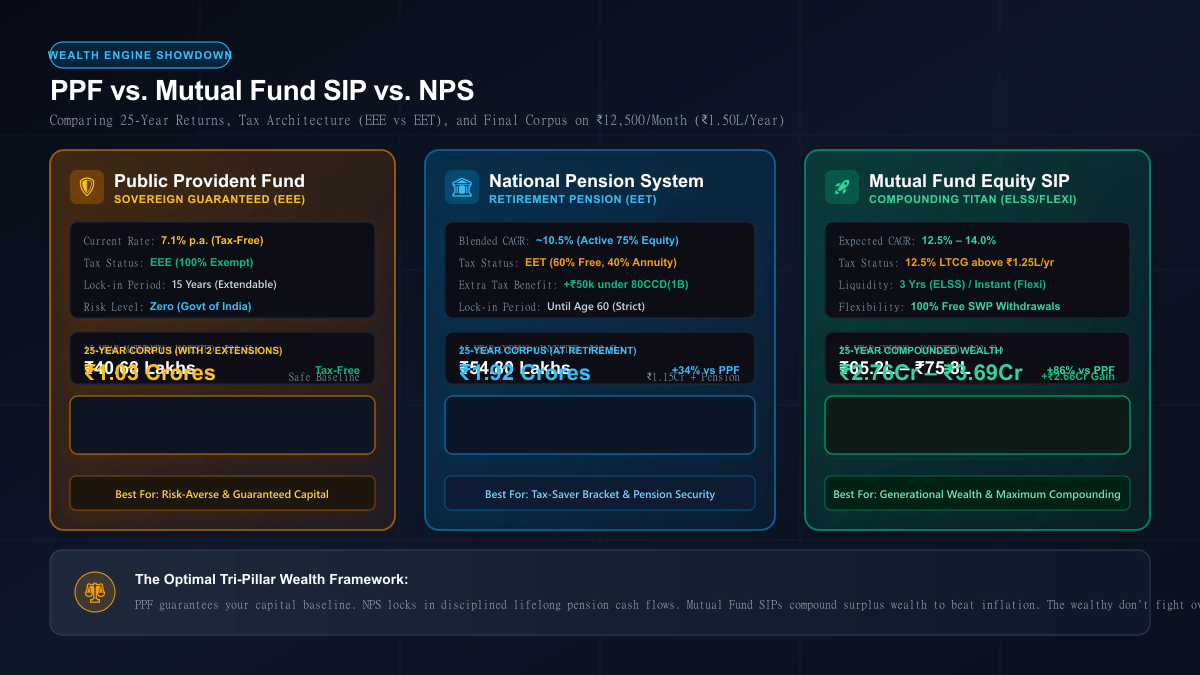
Before examining the nuanced rules of each instrument, let's look at the cold, hard mathematics of compound interest.
Suppose you invest ... per month (... annually / ~$1,570) consistently for 25 years:
- PPF: Compounding at the current sovereign rate of 7.1% p.a. (15 years + two 5-year extensions).
- NPS: Compounding at an expected blended CAGR of 10.5% p.a. (Active Choice with 75% Equity, 15% Corporate Bonds, 10% Govt Securities).
- Equity Mutual Fund SIP (Conservative): Compounding at 12.5% CAGR (Broad market index / Large & Mid Cap fund).
- Equity Mutual Fund SIP (Aggressive): Compounding at 14.0% CAGR (Diversified Flexi-cap & Multi-cap portfolio).
Here is the exact trajectory of your wealth over time:
Master Compounding Table (... / Month Invested):
| Investment Milestone | Total Capital Invested | PPF Corpus (7.1% EEE) | NPS Corpus (10.5% Blended) | Equity SIP @ 12.5% (Pre-Tax) | Equity SIP @ 14.0% (Pre-Tax) | SIP Advantage vs. PPF |
|---|---|---|---|---|---|---|
| Year 5 | ... | ... | ... | ... | ... | +... (+20%) |
| Year 10 | ... | ... | ... | ... | ... | +... (+52%) |
| Year 15 | ... | ... | ... | ... | ... | +... (+86%) |
| Year 20 | ... | ... | ... | ... | ... | +... (+146%) |
| Year 25 | ... | ... | ... | ... | ... | +... (+257%) |
[!IMPORTANT] Over 25 years on a cumulative investment of ... (₹37.5 Lakhs), the difference between 7.1% guaranteed PPF (...) and a 14% Equity SIP (...) is an astronomical ... (₹2.66 Crores / $280,000)! That is more than 7 times your entire original invested capital.
Simulate your custom numbers anytime using our PPF Calculator, NPS Calculator, and SIP Calculator.
Instrument 1: PPF (Public Provident Fund)

Introduced by the Government of India in 1968, the Public Provident Fund remains the gold standard for conservative Indian investors.
Key Characteristics:
- Sovereign Safety: 100% backed by the Central Government. There is zero credit risk, zero volatility, and zero chance of capital loss.
- The EEE Tax Haven: PPF enjoys the coveted Exempt-Exempt-Exempt tax status:
- Exempt at Contribution: Up to ... per year is deductible under Section 80C (Old Tax Regime).
- Exempt at Accumulation: All annual compound interest earned is completely exempt from income tax.
- Exempt at Withdrawal: The entire maturity lump sum after 15 years is 100% tax-free!
- Tenure & Extensions: Mandatory 15-year initial lock-in. After 15 years, you can extend the account indefinitely in 5-year blocks, either with fresh contributions or simply letting the existing balance compound tax-free without depositing another rupee.
- Contribution Limits: Minimum ... and maximum ... per financial year.
The Hidden Flaw: Inflation Drag
While PPF is completely safe, its 7.1% return barely stays ahead of official retail CPI inflation (~5% to 6%). When you factor in lifestyle inflation (healthcare, education, and electronic costs compounding at 8% to 10%), a portfolio invested 100% in PPF loses purchasing power over time.
PPF is built to protect wealth—not to create generational fortune.
Instrument 2: NPS (National Pension System)
Regulated by the Pension Fund Regulatory and Development Authority (PFRDA), the National Pension System is an institutional-grade, low-cost retirement vehicle designed for long-term pension accumulation.
Key Characteristics:
- Active Asset Allocation (Up to 75% Equity): Unlike PPF, NPS lets you invest in equities:
- Asset Class E (Equity): Invests in top-tier Nifty 50 and BSE Sensex stocks (up to 75% under Active Choice).
- Asset Class C (Corporate Debt): High-grade corporate bonds and debentures.
- Asset Class G (Government Securities): Central and state government bonds.
- Asset Class A (Alternative Assets): REITs, InvITs, and venture funds (capped at 5%).
- The Dual Tax Advantage:
- Standard Section 80C deduction up to ....
- Exclusive Section 80CCD(1B) deduction: An additional ... tax deduction over and above the 80C limit! For someone in the 30% tax bracket, this saves an extra ... in taxes every single year.
- Corporate NPS under Section 80CCD(2): Up to 10% of basic salary contributed by your employer is completely tax-deductible under both old and new tax regimes.
- Ultra-Low Cost Structure: NPS fund management charges are capped at just 0.03% to 0.09%, making it one of the cheapest pension products in the world (compared to 0.5%–1.5% for equity mutual funds).
The Exit Restriction (The Age 60 Rule):
NPS has strict liquidity controls to ensure you don't blow your retirement savings prematurely:
- At Age 60: You can withdraw up to 60% of the corpus as a completely tax-free lump sum.
- Mandatory Annuity (40%): You must use the remaining minimum 40% of the corpus to purchase an annuity from an approved life insurer (e.g., LIC, HDFC Life), which pays you a taxable monthly pension for life.
Check your expected monthly pension with our Retirement Calculator.
Instrument 3: Mutual Fund Equity SIP
A Systematic Investment Plan (SIP) in diversified equity mutual funds (Flexi-cap, Large & Mid Cap, or ELSS Tax-Savers) is the most powerful wealth-creation mechanism available to ordinary retail investors.
Key Characteristics:
- Direct Ownership in India's Growth Story: When you invest in a diversified equity mutual fund, you own fractional shares of India's most profitable banking, IT, healthcare, manufacturing, and consumer enterprises (TCS, Reliance, HDFC Bank, Infosys, Larsen & Toubro).
- Uncapped Compounding Returns: Historically over rolling 15 to 20-year periods, diversified Indian equity mutual funds have delivered between 12.5% and 15.0% CAGR, outpacing inflation by a massive 6% to 8% margin.
- Supreme Liquidity:
- Open-Ended Funds: Zero lock-in. You can redeem your money or set up a Systematic Withdrawal Plan (SWP) anytime within 24 to 48 hours without penalty (after the initial 1-year exit load period).
- ELSS Tax-Saver Funds: Shortest tax-saving lock-in of just 3 years (compared to 15 years for PPF and until age 60 for NPS).
- Flexibility: You can increase, decrease, pause, or step up your SIP anytime with zero bureaucratic paperwork. See our guide on How Step-Up SIPs Double Wealth.
The Tax Reality: The New Capital Gains Regime
- Equity LTCG Tax: Long-Term Capital Gains (held for >12 months) are taxed at 12.5% on gains exceeding ... (₹1.25 Lakhs) per financial year.
- Even after deducting 12.5% LTCG tax, a 13.5% equity SIP delivers a net post-tax return of ~12.0%, which still completely eclipses PPF's 7.1%!
The Definitive Feature & Tax Comparison
| Feature | PPF (Public Provident Fund) | NPS (National Pension System) | Mutual Fund Equity SIP |
|---|---|---|---|
| Regulatory Authority | Ministry of Finance (Govt of India) | PFRDA | SEBI |
| Underlying Assets | Government-notified sovereign debt | Equities (up to 75%), Corp Debt, G-Secs | 100% Equity Shares / Stocks |
| Historical / Expected Return | 7.1% p.a. (Fixed quarterly) | 10.0% – 11.5% blended CAGR | 12.5% – 14.5% historical CAGR |
| Risk / Volatility | Zero Risk (Sovereign guarantee) | Moderate (Regulated market risk) | High Volatility in short term, Low in 10+ yrs |
| Lock-in Period | 15 Years (Extendable in 5-yr blocks) | Until Age 60 (Premature exit heavily penalized) | None (Open-ended) / 3 Years (ELSS) |
| Section 80C Tax Deduction | Yes (Up to ₹1.5 Lakhs) | Yes (Up to ₹1.5 Lakhs under 80CCD(1)) | Yes (Only for ELSS funds) |
| Extra Section 80CCD(1B) Tax Deduction | No | Yes (Exclusive extra ₹50,000 deduction!) | No |
| Tax Status | EEE (100% Tax-Free throughout) | EET (60% Lump Sum Free, Annuity Taxed) | Capital Gains (12.5% LTCG above ₹1.25L) |
| Maturity / Withdrawal Rule | 100% Tax-Free cash withdrawal | Min 40% into taxable annuity; 60% cash | 100% Liquid anytime (SWP or Lump Sum) |
| Maximum Annual Deposit | ... per year | No upper limit | No upper limit |
The Real Wealth Impact: Case Study of Priya (Age 30)
Let's test these three vehicles through a real-world scenario.
Meet Priya (30), a marketing director in Pune earning ... per month. She decides to commit ... per month (... / year) toward her retirement at age 55 (a 25-year horizon).
Scenario A: Priya Puts 100% into PPF
- Annual Deposit: ... (Max PPF cap) + ... in a Bank FD.
- Total Capital Invested: ... (₹45.0 Lakhs)
- Total Corpus at Age 55: ... (₹1.18 Crores / $124,000)
- Result: Safe, 100% tax-free, but after 25 years of 6% healthcare and living inflation, ₹1.18 Crores will only buy what ₹27.5 Lakhs buys today. Priya risks outliving her money.
Scenario B: Priya Puts 100% into NPS (75% Equity)
- Total Capital Invested: ...
- Total Corpus at Age 55: ... (₹2.31 Crores / $242,000)
- 60% Tax-Free Lump Sum: ... (₹1.38 Crores in hard cash)
- 40% Mandatory Annuity: ... (Generating ~... monthly taxable pension for life)
- Result: Priya achieves solid retirement security with an automated monthly pension check.
Scenario C: Priya Puts 100% into Equity Mutual Fund SIP
- Total Capital Invested: ...
- Gross Corpus at Age 55 (@ 13.5% CAGR): ... (₹3.95 Crores / $415,000)
- Net Post-Tax Corpus (After 12.5% LTCG): ... (₹3.51 Crores in 100% liquid wealth)
- Result: Priya has three times more liquid wealth than PPF. She can set up a tax-efficient monthly Systematic Withdrawal Plan (SWP) of .../month without ever touching her principal!
The Tri-Pillar Wealth Allocation Strategy
After seeing the data, many investors make the mistake of abandoning PPF and NPS entirely to chase 100% Equity.
That is equally dangerous. Equities experience brutal 30% to 50% bear markets (like 2008 and 2020). If a market crash hits the year you plan to retire, having 100% in equities will force you to sell shares at rock-bottom prices.
Smart wealth managers don't choose between PPF, NPS, and SIPs. They combine all three into an integrated, anti-fragile portfolio:
flowchart TD
    Income["Monthly Investment Surplus (e.g. ₹30,000)"] --> P1["60% Equity Mutual Fund SIP<br/>(₹18,000 / mo)<br/>• Generational Compounding Engine<br/>• Beats Inflation by 6-8%<br/>• 100% Liquid via SWP"]
    Income --> P2["25% NPS Contribution<br/>(₹7,500 / mo)<br/>• Captures Extra ₹50k 80CCD(1B) Tax Deduction<br/>• Guaranteed Post-60 Monthly Pension<br/>• Regulated Low-Cost Equity Exposure"]
    Income --> P3["15% PPF / EPF<br/>(₹4,500 / mo)<br/>• 100% Sovereign Safe Haven (EEE)<br/>• Recession Insurance<br/>• Zero Market Volatility"]
The Recommended Allocation Rule:
- The Core Growth Engine (60% to 70% in Equity Mutual Funds): Put the lion's share of your monthly surplus into diversified Flexi-cap, Mid-cap, and Large-cap mutual fund SIPs. This is the only engine powerful enough to beat inflation and create true wealth.
- The Tax-Saving Pension Pillar (20% in NPS): Invest ... annually into NPS to claim the exclusive Section 80CCD(1B) tax deduction. Select the Active Choice with 75% Equity (Scheme E) to maximize growth within the pension wrapper.
- The Sovereign Defense Pillar (10% to 15% in PPF or EPF): Maintain your PPF account with at least ... to ... per year. It serves as your bulletproof debt allocation, providing tax-free capital preservation that you can extend indefinitely.
Check your overall asset distribution on our Net Worth Calculator.
Frequently Asked Questions (FAQ)
Can I have both a PPF account and an NPS account at the same time?
Yes, absolutely. You can hold both accounts simultaneously. In fact, doing so provides optimal diversification across sovereign debt (PPF) and market-linked equity pension (NPS).
Which is better under the New Tax Regime: PPF, NPS, or Mutual Funds?
Under the New Tax Regime (Budget 2023 onwards), deductions under Section 80C and Section 80CCD(1B) are not available.
- However, Employer contributions to NPS under Section 80CCD(2) are still 100% tax-deductible up to 10% of basic salary!
- For personal investments under the New Regime, Equity Mutual Funds are clearly superior because the tax deduction reason for locking money into PPF or NPS no longer applies, giving you full liquidity and superior 13%–14% compounding.
- Compare tax liabilities under both regimes on our Old vs. New Tax Regime Calculator.
What happens if I miss a yearly deposit in PPF or NPS?
- PPF: If you fail to deposit the minimum ... in a financial year, the account becomes inactive. You can revive it anytime by paying a nominal penalty fee of ... per lapsed year plus the arrears.
- NPS Tier-1: If you fail to deposit the minimum ... per year, the PRAN becomes frozen. You can unfreeze it online by paying a ... penalty and depositing ....
Can I withdraw my NPS corpus before age 60?
Premature withdrawals from NPS Tier-1 are heavily discouraged. If you exit before age 60, you are mandated to use 80% of your total accumulated corpus to buy an annuity, and only 20% can be withdrawn as a lump sum. Partial withdrawals up to 25% of your self-contribution are permitted only after 3 years for critical illnesses, children's higher education, or buying a first home.