Loading page
Financial Guide
Debt Avalanche vs. Debt Snowball: The Mathematical Payoff Guide
13 min read

Few things in modern financial life induce more silent panic than the 1st of the month. The notification chimes on your phone: minimum credit card payments due, personal loan EMIs deducted, buy-now-pay-later (BNPL) installments pending, and car loan installments auto-debited.
Before you have even purchased groceries or paid rent, a massive chunk of your hard-earned salary has evaporated into thin air.
flowchart TD
    A["Multiple Consumer Debts<br/>(Credit cards, personal loans, BNPL)"] --> B["The Minimum Payment Illusion<br/>(Interest compounds at 36% - 42% APR)"]
    B --> C["Cash Flow Suffocation<br/>(Zero surplus for savings or equity SIPs)"]
    C --> D["Financial Fragility<br/>• One unexpected medical bill triggers new loans<br/>• Paralyzing anxiety and chronic career stress"]
When you are carrying multiple loans, the problem is rarely just the principal balance—it is the mental fragmentation. You are juggling four different due dates, four different lender portals, and four different interest rates.
Even worse, commercial banks design their billing statements around a predatory psychological trick: the "Minimum Amount Due" (MAD).
[!WARNING] Paying only the minimum required payment (typically 5% of the balance) on a ... (₹1.0 Lakh / $1,050) credit card balance at 42% APR will take over 18 years and 4 months to pay off, costing you more than ... in pure interest alone! You end up paying the bank nearly triple what you originally borrowed.
To escape this compounding quicksand, you need a systematic, algorithmic plan of attack. In the world of personal finance, two battle-tested frameworks dominate:
- The Debt Avalanche Method (The Mathematical Optimization Strategy)
- The Debt Snowball Method (The Behavioral Dopamine Strategy)
Let's dissect the exact mechanics of both approaches, run a rigorous mathematical comparison across a realistic multi-debt scenario, and discover which framework will get you debt-free fastest.
The Two Frameworks Explained
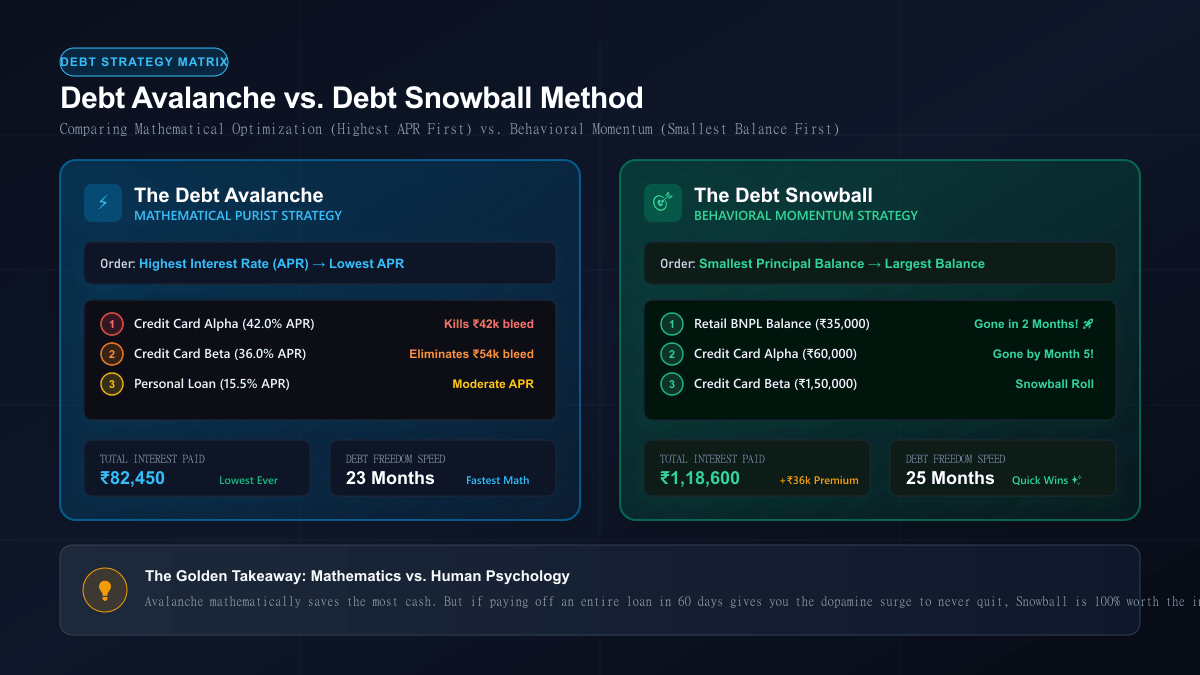
Both methods share the same ironclad prerequisite: you must pay the mandatory minimum payment on every single debt except one.
All your extra surplus cash flow—every spare rupee or dollar you can squeeze from your monthly budget—is then aggressively channeled into a single target debt until it is completely obliterated.
Where the two systems diverge is in how they choose that target debt:
flowchart LR
    subgraph Avalanche["The Debt Avalanche"]
        A1["Rank debts by APR%<br/>(Highest to Lowest)"] --> A2["Attack Highest APR<br/>(e.g., 42% Credit Card)"]
        A2 --> A3["Maximum Interest Saved<br/>(Fastest Mathematical Freedom)"]
    end

    subgraph Snowball["The Debt Snowball"]
        S1["Rank debts by Balance<br/>(Smallest to Largest)"] --> S2["Attack Smallest Balance<br/>(e.g., ₹35k Retail Loan)"]
        S2 --> S3["Instant Psychological Win<br/>(Momentum Prevents Quitting)"]
    end
1. The Debt Avalanche (Highest Interest Rate First)
With the Avalanche method, you organize all your debts in descending order of Annual Percentage Rate (APR), completely ignoring the loan balance:
- You target the loan bleeding the highest interest percentage first (e.g., credit cards at 36%–42% APR).
- You make minimum payments on all other loans (personal loans, auto loans, student loans).
- Once the highest-APR debt hits zero, you roll its entire monthly payment into the next highest-APR debt.
The Philosophy: Pure, unadulterated mathematical efficiency. You eliminate the most expensive financial leak in your boat first. Every month that high-APR debt dies saves you the maximum possible amount of compound interest.
2. The Debt Snowball (Smallest Principal Balance First)
Popularized by financial author Dave Ramsey, the Debt Snowball method organizes all your debts in ascending order of outstanding principal balance, completely ignoring the interest rate:
- You target the smallest balance first (e.g., a ... store credit or BNPL balance), regardless of whether its interest rate is 12% or 36%.
- You make minimum payments on everything else.
- Once that tiny debt is completely eradicated, you cross an entire loan account off your list. You take the money you were paying toward it and "roll" it into the next smallest balance. Like a snowball rolling downhill, your monthly attack payment grows larger with every eliminated account.
The Philosophy: Human psychology over pure mathematics. Personal finance is 20% head knowledge and 80% behavior. Seeing a loan account vanish within 60 to 90 days triggers a massive dopamine release, destroying feelings of hopelessness and motivating you to stick with the plan.
Head-to-Head Case Study: The Mathematical Proof
To see how these two philosophies perform in real life, let's analyze an actual household scenario.

Meet Amit (29), a software professional who accumulated multiple consumer liabilities during an apartment relocation and wedding.
Amit's Debt Profile:
Amit owes a total of ... (₹5.45 Lakhs / $5,720) distributed across four separate accounts:
| Debt Account | Principal Balance | Interest Rate (APR) | Mandatory Min Payment / EMI | Account Type |
|---|---|---|---|---|
| Debt A: Retail BNPL / Store Card | ... | 12.0% APR | ... / mo | Small consumer gadget installment |
| Debt B: Credit Card Alpha | ... | 42.0% APR (3.5%/mo) | ... / mo | High-interest revolving balance |
| Debt C: Credit Card Beta | ... | 36.0% APR (3.0%/mo) | ... / mo | High-interest lifestyle spending |
| Debt D: Unsecured Personal Loan | ... | 15.5% APR | ... / mo | 3-Year reducing balance loan |
| TOTALS | ... | Weighted: ~22.6% | ... / mo | 4 Separate Lenders |
Amit's absolute bare minimum monthly commitment just to stay in good standing with credit bureaus is ... per month.
By cutting dining out, canceling unused subscriptions, and optimizing his monthly expenses using our 50/30/20 Budget Calculator, Amit commits a total monthly debt-slaying budget of ... per month.
That gives him a powerful monthly debt accelerator surplus of ... (... minus ...).
Now, let's run the numbers across all three potential strategies:
Strategy 1: The "Minimum Payments Only" Trap
If Amit simply makes the minimum required payments every month and doesn't apply his extra ... surplus:
flowchart LR
    M1["Pay Minimum Amount Due<br/>(₹22,485 / mo)"] --> M2["80% of Payment Goes to Interest<br/>(Principal barely decreases)"]
    M2 --> M3["The Bank's Golden Goose<br/>• Payoff Time: 19 Years, 4 Months<br/>• Total Interest: ₹7,82,400<br/>• Total Outflow: ₹13,27,400"]
- Months to Become Debt-Free: 232 Months (19 Years and 4 Months!)
- Total Interest Paid to Lenders: ... (₹7.82 Lakhs / $8,200)
- Total Cash Outflow: ... (₹13.27 Lakhs)
- Verdict: Financial suicide. Amit pays more than 1.4 times his entire original debt in interest alone. The personal loan is paid off in 3 years, but the 42% and 36% credit cards drag out for nearly two decades.
Calculate your exact credit card payoff timeline with our free Credit Card Payoff Calculator.
Strategy 2: The Debt Snowball Method (Smallest Balance First)
Under the Snowball method, Amit lists his debts strictly from smallest balance to largest:
- Target #1: Retail BNPL (... balance | 12% APR)
- Target #2: Credit Card Alpha (... balance | 42% APR)
- Target #3: Credit Card Beta (... balance | 36% APR)
- Target #4: Personal Loan (... balance | 15.5% APR)
Amit pays minimums on Debts B, C, and D (... + ... + ... = ...). He throws his remaining ... (... min + ... surplus) directly at the Retail BNPL debt.
The Snowball Payoff Progression:
| Month Range | Primary Target Account | Monthly Payment on Target | What Happens | Psychological Impact |
|---|---|---|---|---|
| Month 1 – 3 | Retail BNPL (...) | ... | DEBT 1 PAID OFF IN 2.5 MONTHS! 🎉 | Enormous Victory! 1 whole lender eliminated from his life. |
| Month 3 – 6 | Credit Card Alpha (...) | ... (14,515 + 3,000) | DEBT 2 PAID OFF BY MONTH 6! 🚀 | Two accounts closed in under half a year. Amit feels invincible. |
| Month 7 – 12 | Credit Card Beta (...) | ... (17,515 + 7,500) | DEBT 3 PAID OFF BY MONTH 12! 🔥 | All high-interest revolving credit cards are 100% gone! |
| Month 13 – 20 | Personal Loan (...) | ... (Entire budget!) | 100% DEBT-FREE AT MONTH 20! 🏆 | Zero debt remains. Amit is free. |
Snowball Results:
- Months to Become Debt-Free: 20 Months (1 Year, 8 Months)
- Total Interest Paid: ...
- Total Cash Outflow: ...
Notice the brilliance of the behavioral snowball: In just 75 days, Amit completely killed his first debt. In 6 months, half of his debts were gone forever. That momentum kept him hungry and disciplined.
Strategy 3: The Debt Avalanche Method (Highest APR First)
Under the Avalanche method, Amit lists his debts strictly by interest rate:
- Target #1: Credit Card Alpha (42.0% APR | ...)
- Target #2: Credit Card Beta (36.0% APR | ...)
- Target #3: Personal Loan (15.5% APR | ...)
- Target #4: Retail BNPL (12.0% APR | ...)
Amit pays minimums on the BNPL, Credit Card Beta, and Personal Loan (... + ... + ... = ...). He throws his remaining ... (... min + ... surplus) directly at Credit Card Alpha.
The Avalanche Payoff Progression:
| Month Range | Primary Target Account | Monthly Payment on Target | What Happens | Economic Advantage |
|---|---|---|---|---|
| Month 1 – 4 | Credit Card Alpha (42% APR) | ... | Killed in 4.2 Months! | Stops the most aggressive 42% interest bleed immediately. |
| Month 5 – 10 | Credit Card Beta (36% APR) | ... (15,515 + 7,500) | Killed by Month 10! | All credit card interest (36-42%) terminated permanently. |
| Month 11 – 18 | Personal Loan (15.5% APR) | ... (23,015 + 9,985) | Killed by Month 18! | The largest balance is decimated in just 8 months. |
| Month 19 | Retail BNPL (12% APR) | ... | Killed in Month 19 in ONE single check! | Balance was only ₹18k remaining. Paid in full. |
Avalanche Results:
- Months to Become Debt-Free: 19 Months (1 Month Faster than Snowball!)
- Total Interest Paid: ...
- Total Cash Outflow: ...
- Net Interest Saved vs. Snowball: ... in pure cash!
- Net Interest Saved vs. Minimum Payments: ... saved!
The Master Comparison Table
Let's place all three methods side by side so the economic reality is unmistakably clear:
| Metric | Minimum Payments Only | The Debt Snowball | The Debt Avalanche | Avalanche Advantage vs Snowball |
|---|---|---|---|---|
| Order of Attack | Pay minimums forever | Smallest balance first | Highest interest rate (APR) first | — |
| First Account Closed | Month 36 (Personal Loan) | Month 2.5 (BNPL) ⚡ | Month 4.2 (Card Alpha) | Snowball is 1.7 months faster to 1st win |
| All Credit Cards Gone | Month 232 (19+ years) | Month 12 | Month 10 | Avalanche eliminates toxic cards 2 months earlier |
| Total Debt Freedom Date | 19 Years, 4 Months | 20 Months | 19 Months | Avalanche finishes 1 month faster |
| Total Interest Paid | ... | ... | ... | Avalanche saves ... cash! |
| Total Money Out of Pocket | ... | ... | ... | Save ₹23,100 ($242) in hard cash |
| Primary Driver | Procrastination / Bank Profit | Emotional Dopamine & Quick Wins | Cold Mathematical Optimization | — |
Explore loan interest dynamics with our Personal Loan Calculator and Flat vs. Reducing Balance Loan Calculator.
Which Method Should You Choose?
Now that the mathematical facts are on the table, which strategy should you execute?
flowchart TD
    Start["Do you have multiple high-interest debts?"] --> Q1{"Are you easily stressed by debt<br/>and prone to giving up?"}
    Q1 -- "Yes, I need emotional motivation" --> Snowball["CHOOSE THE DEBT SNOWBALL<br/>• Rapid quick wins in 60-90 days<br/>• Lowers cognitive overload<br/>• Cost: ₹20k - ₹30k extra in interest"]
    Q1 -- "No, I am hyper-analytical & disciplined" --> Avalanche["CHOOSE THE DEBT AVALANCHE<br/>• Mathematically optimal<br/>• Lowest possible interest paid<br/>• Saves maximum cold hard cash"]
Choose the Debt Avalanche If:
- You are analytical and numbers-driven: Seeing money go toward high interest physically bothers you.
- Your interest rates have a massive spread: If you have credit cards at 42% APR alongside an education or car loan at 9%, the Avalanche method will save you tens of thousands of rupees.
- You have the patience to wait 4–6 months for your first payoff: You don't need immediate emotional gratification to stay disciplined.
Choose the Debt Snowball If:
- You feel overwhelmed, paralyzed, or anxious: If looking at four different bills makes you want to throw your hands up in defeat, you need quick psychological wins.
- You have several small, annoying balances: If you have 3 small balances under ... (retail cards, unpaid medical bills, small personal loans), wiping them out in 90 days frees up massive mental bandwidth.
- You have struggled with budgeting in the past: Harvard Business Review researchers studied debt repayment across thousands of consumers and found that the number of accounts closed was a far stronger predictor of completing the debt journey than the dollar amount of interest saved.
[!TIP] The Hybrid "Snow-valanche" Approach: You don't have to be a purist! Many people start with the Snowball for the first 60 days to knock out 1 or 2 tiny nuisance accounts and gain confidence. Then, with momentum established, they switch seamlessly to the Avalanche to attack their 36%–42% credit card monsters.
Three Turbochargers to Accelerate Debt Freedom
Regardless of whether you choose the Avalanche or the Snowball, you can shave months off your timeline using these three strategies:
1. The "Debt Snowflake" Method
While the Snowball and Avalanche rely on your regular monthly salary surplus, the Debt Snowflake technique utilizes micro-prepayments from unexpected or non-recurring cash windfalls:
- Selling unused electronics, furniture, or designer clothes on marketplace apps.
- Directing 100% of annual company performance bonuses, festival gifts, and tax refunds directly to your target debt principal.
- Depositing freelance or side-gig income within 24 hours of receiving it.
A single surprise prepayment of ... made in Month 3 of Amit's repayment schedule would have saved an additional ... in interest and shaved nearly two full months off his journey!
2. Loan Refinancing or Balance Transfer
If your credit score is still decent (above 750), you can explore transferring high-interest credit card debt (36%–42% APR) into a lower-interest personal loan or a 0% interest balance transfer card (typically 12%–14% APR).
- The Caveat: Never consolidate debt if you haven't fixed the underlying spending habit. People who consolidate without budgeting often run up new credit card balances, doubling their total liability.
- Check options using our Loan Refinance Calculator.
3. The "Zero-Based" Emergency Buffer
A common pitfall is throwing literally every single rupee at your debt, leaving exactly ... in your bank account. When a car tire punctures or a tooth needs a root canal, you are forced to swipe your credit card again, undoing your progress.
- Maintain a lean "starter" emergency fund of ... to ... in a high-yield liquid account before initiating an aggressive debt payoff.
- Read our full guide on How to Build an Emergency Fund.
The Wealth Cascade: From Debt-Free to Multi-Millionaire
The most exhilarating part of becoming debt-free is not just reaching zero—it is the astonishing wealth-building machine you unlock the very next day.
Look back at Amit's scenario. In Month 19, he makes his final payment. The Personal Loan, the Credit Cards, and the BNPL are dead.
On Month 20, Amit wakes up with ... ($367) of unencumbered, free cash flow every single month.
What happens if Amit takes that exact same ... monthly payment and redirects it into a diversified Equity Mutual Fund SIP generating a historical 12% CAGR?
The Wealth Creation Cascade (... / Month @ 12% CAGR):
| Timeframe After Debt Freedom | Total Cash Invested | Wealth Compounded (12% CAGR) | Financial Milestone Unlocked |
|---|---|---|---|
| Year 3 | ... | ... (₹15.2 Lakhs / $16k) | Bulletproof 1-year emergency reserve + peace of mind |
| Year 5 | ... | ... (₹28.8 Lakhs / $30k) | Down payment on a sensible primary home |
| Year 10 | ... | ... (₹81.3 Lakhs / $85k) | Financial independence milestone for children's higher education |
| Year 15 | ... | ... (₹1.76 Crores / $185k) | Early retirement / Lean FIRE readiness |
| Year 20 | ... | ... (₹3.50 Crores / $367k) | Complete generational financial freedom! 👑 |
flowchart LR
    A["Trapped Borrower<br/>(₹35,000/mo pays banks ₹7.8L interest)"] -->|Execute Avalanche / Snowball in 19 Months| B["Debt Free at Zero<br/>(100% of paycheck belongs to you)"]
    B -->|Redirect ₹35,000/mo into 12% Equity SIP| C["Multi-Crore Wealth Machine<br/>• ₹81 Lakhs in 10 Years<br/>• ₹3.50 Crores in 20 Years"]
The very same monthly cash flow that once made your bankers rich can make you and your family financially independent. All it requires is 18 to 24 months of fierce, structured focus.
Frequently Asked Questions (FAQ)
Should I pause my mutual fund SIPs while paying off credit card debt?
Yes, absolutely. If your credit card charges 36% to 42% APR, paying it off provides an immediate, guaranteed, risk-free return of 36% to 42%. No mutual fund, stock, or real estate investment on earth offers a guaranteed 42% post-tax return. Pause discretionary equity SIPs temporarily, obliterate your toxic card debt, and then resume SIPs with double the monthly volume.
The only exception: If your employer offers a matching contribution on a 401(k) or NPS, contribute just enough to capture the 100% free match, then direct all remaining surplus toward high-interest debt.
Will closing paid-off credit cards hurt my credit score?
In the short term, closing an old credit card can slightly increase your overall credit utilization ratio and reduce your average account age. However, if having the credit card temptation open will cause you to run up debt again, cancel it immediately. Mental peace and debt freedom are infinitely more valuable than a 15-point swing in a credit bureau score.
Should I pay off my home loan or auto loan early using Avalanche?
Home loans (typically 8.5%–9.0% APR) and car loans (8.5%–10% APR) are low-interest, collateralized liabilities. While you should systematically prepay high-interest debt (anything above 12% APR), low-rate home loans can often be comfortably serviced while simultaneously investing in equity mutual funds. Check our guide on Prepaying Home Loan vs. Investing in SIP.
What if I cannot afford even the minimum payments?
If your income cannot cover even the minimum required payments, you are in hardship territory. Contact your lenders immediately before missing payments. Ask for:
- Converting credit card balances into a fixed-term personal loan EMI at a reduced rate.
- A moratorium or interest-rate waiver program.
- A formal debt settlement restructuring program through an accredited non-profit credit counseling agency.