Loading page
Financial Guide
401(k) vs. Traditional IRA vs. Roth IRA: Which Builds More Wealth After Taxes?
16 min read

The Modern Retirement Dilemma
Every year, millions of working professionals ask the exact same high-stakes question when reviewing their company benefits and personal investments:
"I have ... to ... a month to invest for retirement. Should I put it into my workplace Traditional 401(k) for an immediate tax write-off, choose a Roth 401(k), or open a separate Roth IRA with an independent brokerage?"
The confusion is understandable. The modern retirement landscape is cluttered with financial jargon, shifting IRS contribution limits, phase-out thresholds, and conflicting advice from Wall Street:
- The Traditionalist: "Always take the upfront deduction! A dollar saved in taxes today can be invested right now. Pay the taxes decades later when you're retired and in a lower tax bracket."
- The Roth Maximalist: "Taxes are historically low and government debt is skyrocketing. Pay taxes now so every penny of compounding growth and future retirement withdrawals is 100% tax-free forever!"
- The Overwhelmed Saver: "My company offers both, but I don't know the difference—so I just leave my money sitting in a default money market fund or a high-fee target-date fund."
flowchart TD
A["Monthly Retirement Savings<br/>($500 - $2,000 / month)"] --> B{"Does Employer Offer a 401(k) Match?"}
B -- "YES: Free Money" --> C["Step 1: 401(k) Up to Match<br/>• Instant 50% - 100% return<br/>• Never leave match on table"]
B -- "NO / Match Maxed" --> D{"Income Below Roth IRA Limit?"}
C --> D
D -- "YES (< $150k Single / $236k Married)" --> E["Step 2: Max Out Roth IRA<br/>• $7,000 annual limit<br/>• 100% tax-free growth<br/>• Unlimited investment choices"]
D -- "NO (High Earner)" --> F["Step 2B: Backdoor Roth IRA<br/>• Non-deductible IRA conversion<br/>• Bypasses income ceiling"]
E & F --> G["Step 3: Return to 401(k)<br/>• Max up to $23,500 IRS cap<br/>• Traditional or Roth 401(k)"]
G --> H["Step 4: Taxable Brokerage / HSA<br/>• Unlimited liquidity<br/>• Capital gains efficiency"]
The truth is that you do not have to choose just one vehicle. In fact, relying exclusively on either Traditional or Roth creates dangerous financial vulnerabilities.
To build a bulletproof retirement, you must master the Tax Diversification Strategy and follow the 4-Step Retirement Waterfall.
Let's dissect the mechanics of each account, run a 30-year mathematical compounding showdown, and reveal how the wealthiest savers optimize their tax buckets.
The 4-Step Retirement Investment Waterfall
Before deciding between Traditional and Roth tax structures, you must know where your first dollar goes. Wealth managers use a disciplined hierarchy known as the Retirement Investment Waterfall:
Step 1: Capture 100% of Your Employer 401(k) Match
If your employer offers a matching contribution (e.g., "50% match up to 6% of your salary"), your first priority is contributing enough to capture every single matching dollar.
- On a ... salary, contributing 6% (...) triggers an immediate ... company contribution.
- That is an instant, risk-free 50% return on investment on day one—before your investments even begin compounding.
- Never skip this step. No index fund, real estate deal, or crypto asset can guarantee a 50% to 100% immediate return. You can test your exact company formula on our 401(k) Calculator.
Step 2: Max Out a Roth IRA ($7,000 Annual Limit)
Once you capture the full employer match, redirect your next investment dollars into an independent Roth IRA:
- Why prioritize the IRA over the 401(k)? Most workplace 401(k) plans restrict you to a limited menu of 15 to 25 pre-selected mutual funds, many of which carry higher administrative fees (0.30% to 0.85%).
- A Roth IRA opened at an independent brokerage (Vanguard, Fidelity, Schwab) grants you access to virtually any low-cost index ETF with expense ratios as low as 0.03%.
- Furthermore, Roth IRAs allow you to withdraw your direct contributions at any time without taxes or penalties.
Step 3: Return to Your 401(k) and Max Out the IRS Ceiling
If you have surplus funds after maxing out your Roth IRA, return to your employer 401(k) and increase your contributions up to the ... annual employee elective deferral ceiling (... if age 50 or older).
Step 4: Health Savings Account (HSA) & Taxable Brokerage
If you still have surplus cash:
- HSA (The Triple-Tax Threat): If enrolled in a High-Deductible Health Plan (HDHP), an HSA offers tax-deductible contributions, tax-free growth, and tax-free withdrawals for medical expenses.
- Taxable Brokerage Account: Offers unlimited liquidity, zero contribution caps, and favorable long-term capital gains tax rates (0%, 15%, or 20%).
30-Year Compounding Showdown: Matrix & Chart
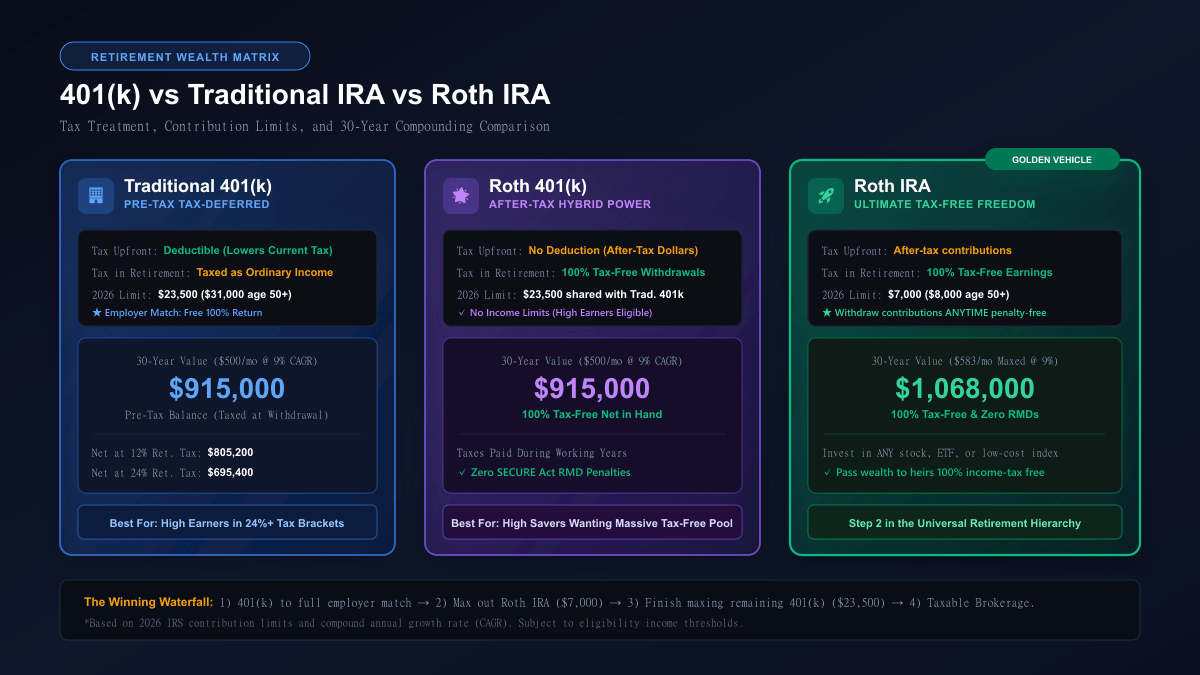
To compare how these accounts build wealth over a career, let's model a standardized 30-year scenario:
- Monthly Contribution: ... per month (... annually).
- Time Horizon: 30 years (e.g., investing from age 30 to age 60).
- Compounding Rate: Conservative 9.0% CAGR (broad market index fund like the S&P 500 or Total Stock Market Index).
- Total Principal Invested: ... over 30 years.
The Mathematical Accumulation Formula:
$$\text{Future Value} = P \times \frac{(1 + r/n)^{nt} - 1}{r/n}$$
Where $P = \text{CURRENCY:500}$, $r = 0.09$, $n = 12$, and $t = 30$ years:
$$\text{Total Pre-Tax Corpus} \approx \text{CURRENCY:915372}$$
Now, let's examine what you actually take home under three different tax scenarios in retirement:
30-Year Net Wealth Comparison Table (... / Month Invested):
| Account Type | Total Deposited | Ending Balance (Age 60) | Tax Paid During Working Years | Estimated Tax at Withdrawal | Net Spendable Retirement Wealth |
|---|---|---|---|---|---|
| Traditional 401(k) / IRA (Low Ret. Tax: 12%) | ... | ... | ... (Deducted upfront) | ... (12%) | ... |
| Traditional 401(k) / IRA (Mid Ret. Tax: 22%) | ... | ... | ... (Deducted upfront) | ... (22%) | ... |
| Traditional 401(k) / IRA (High Ret. Tax: 32%) | ... | ... | ... (Deducted upfront) | ... (32%) | ... |
| Roth 401(k) / Roth IRA (Taxes Paid Upfront) | ... | ... | Paid via paycheck | ... (100% Tax-Free) | ... |
What the Numbers Reveal:
- In a Traditional account, you defer taxes today, but every single penny of compounding interest and market gains is taxed as ordinary income when withdrawn in retirement.
- In a Roth account, you pay taxes only on your initial contributions. The entire ... in accumulated investment growth is 100% legally tax-free.
- If tax brackets rise in the future or your retirement income pushes you into a 22%+ bracket, the Roth account delivers between ... and ... more spendable net cash in your pocket.
Simulate your custom salary, matching formula, and timeline with our 401(k) Calculator and compare with our Retirement Corpus Calculator.
Deep Dive: The 401(k) (Traditional vs. Roth)
A 401(k) is an employer-sponsored qualified retirement plan defined under Section 401(k) of the Internal Revenue Code. Today, over 80% of US corporate employers offer both a Traditional 401(k) and a Roth 401(k) option within the same company plan.
2026 IRS 401(k) Contribution Limits:
- Employee Elective Deferral: ... (up from $23,000 in previous tax years).
- Age 50+ Catch-Up Contribution: Additional ..., bringing the total employee limit to ....
- SECURE 2.0 Super Catch-Up (Ages 60, 61, 62, 63): Savers in this special age window can contribute an enhanced catch-up limit of ..., for a maximum total of ....
- Total Combined Plan Limit (Employee + Employer Match): Up to ... (or ... for age 50+).
flowchart LR
    subgraph Traditional_401k ["Traditional 401(k)"]
        T1["Paycheck Gross Income"] -->|"Pre-Tax Deduction"| T2["401(k) Balance ($23,500 max)"]
        T2 -->|"Tax-Deferred Growth"| T3["Retirement Balance"]
        T3 -->|"Taxed as Ordinary Income (Age 59½)"| T4["Net Cash"]
    end
    subgraph Roth_401k ["Roth 401(k)"]
        R1["Paycheck Gross Income"] -->|"Income Tax Withheld"| R2["Roth 401(k) ($23,500 max)"]
        R2 -->|"Tax-Free Growth"| R3["Retirement Balance"]
        R3 -->|"100% Tax-Free (Age 59½)"| R4["Net Cash"]
    end
Traditional 401(k) Mechanics:
- Upfront Tax Relief: Contributions reduce your taxable income dollar-for-dollar for the current tax year. If you earn ... and contribute ..., your W-2 taxable wage drops to ..., saving you ... in federal taxes in the 24% bracket.
- Tax-Deferred Compounding: You pay no capital gains taxes or dividend taxes while the money remains inside the plan.
- Taxable Distributions: Every distribution taken after age 59½ is taxed as regular earned income.
Roth 401(k) Mechanics:
- No Upfront Deduction: Contributions are made with after-tax dollars. Your current taxable income does not decrease.
- 100% Tax-Free Withdrawals: All earnings compound completely tax-free. Qualified distributions after age 59½ (provided the account has been open for at least 5 years) are 100% tax-free.
- No Income Cap: Unlike a Roth IRA (which bans high earners from contributing directly), anyone can contribute to a Roth 401(k), regardless of whether you make $50,000 or $5,000,000 a year.
- SECURE 2.0 Eliminates RMDs: Starting in 2024, Roth 401(k)s are no longer subject to Required Minimum Distributions (RMDs) during the owner's lifetime, matching the rule for Roth IRAs.
Deep Dive: The Roth IRA (The Swiss Army Knife)
An Individual Retirement Arrangement (IRA) is an account you set up yourself at a financial institution, independent of your employer. Among all retirement accounts, the Roth IRA offers the greatest flexibility, legal protection, and tax advantages.

Why Savvy Investors Revere the Roth IRA:
1. The Ultimate Principal Withdrawal Rule
Unlike 401(k) plans (which impose a 10% penalty plus income tax for early withdrawals), the IRS treats Roth IRA withdrawals under strict ordering rules: contributions come out first.
- If you deposit ... a year for 5 years (... total) and the account grows to ...:
- You can withdraw your original ... in contributions at any time, at any age, for any reason, completely tax-free and penalty-free.
- Only the ... in earnings is locked until age 59½.
- While you should avoid raiding your retirement funds, this feature serves as a secondary emergency backstop.
2. Complete Investment Freedom
In a workplace 401(k), you are trapped with whatever plan custodian (Fidelity, Empower, Principal) your HR department selected. In a Roth IRA, you have access to the entire global stock and bond universe:
- Low-cost index ETFs (Vanguard VTI, VOO, VXUS).
- Individual dividend growth stocks.
- Target-date index funds.
- Zero custodial fees and zero trade commissions.
3. 2026 Roth IRA Income Limits:
Because the tax advantages are so potent, the IRS caps who can contribute directly based on Modified Adjusted Gross Income (MAGI):
- Single Filers: Phase-out begins at ..., completely ineligible above ....
- Married Filing Jointly: Phase-out begins at ..., completely ineligible above ....
- 2026 Contribution Limit: ... per year (... if age 50 or older).
Deep Dive: The Traditional IRA
A Traditional IRA functions similarly to a Traditional 401(k): you contribute pre-tax dollars (or claim a tax deduction), investments grow tax-deferred, and withdrawals are taxed in retirement.
However, there is a major catch: The Active Participant Phase-Out Rule. If you or your spouse are already covered by an employer retirement plan (like a 401(k)) at work, the ability to deduct Traditional IRA contributions phases out at surprisingly low income levels:
- Single Filers Covered by Work Plan: Deduction phases out between ... and ... MAGI.
- Married Filing Jointly (Covered): Deduction phases out between ... and ... MAGI.
[!WARNING] If your income is above these phase-out limits, contributing to a Traditional IRA gives you no tax deduction today, yet your earnings are still locked until age 59½ and taxed as ordinary income upon withdrawal. This is a non-deductible Traditional IRA—and unless you are immediately executing a Backdoor Roth conversion, it is the worst possible place to hold your money!
The Tax Bracket Crossover: How to Choose
The decision between Traditional (pre-tax) and Roth (after-tax) boils down to one fundamental comparison:
$$\text{Your Marginal Tax Rate Today} \quad \text{vs.} \quad \text{Your Effective Tax Rate in Retirement}$$
flowchart TD
Q{"Compare Current Tax Bracket vs Expected Retirement Bracket"}
Q -- "Current Bracket > Retirement Bracket<br/>(e.g., in 32% - 37% bracket now)" --> TRAD["Choose Traditional 401(k)<br/>• Pocket big upfront deduction<br/>• Pay lower tax rate in retirement"]
Q -- "Current Bracket < Retirement Bracket<br/>(e.g., in 10% - 22% bracket now)" --> ROTH["Choose Roth 401(k) / Roth IRA<br/>• Lock in low tax rate today<br/>• Enjoy 100% tax-free withdrawals"]
Q -- "Uncertain / Brackets Likely Equal" --> HYB["Split 50/50 (Tax Diversification)<br/>• Max match in Trad 401(k)<br/>• Max personal Roth IRA"]
When Traditional 401(k) Wins:
- You are in your peak earning years: If your household income sits in the 24%, 32%, 35%, or 37% federal tax brackets (plus state taxes in high-tax states like California, New York, or New Jersey), saving 30% to 45% on every invested dollar today is difficult to beat.
- You expect lower retirement spending: In retirement, you will no longer have mortgage payments, commuting costs, payroll FICA taxes, or the need to save 20% of your income. Your income needs—and thus your effective tax rate—will likely be lower.
When Roth 401(k) and Roth IRA Win:
- You are in the 10%, 12%, or 22% tax brackets: Paying 12% in taxes today to guarantee tax-free compounding for 30 years is one of the greatest bargains in the tax code.
- You want protection against future statutory tax hikes: The US national debt exceeds $35 trillion. Many economists project that future income tax rates will inevitably rise to fund Medicare and Social Security obligations.
- Estate Planning: Roth IRAs have no Required Minimum Distributions (RMDs) during your lifetime. When passed to heirs, the beneficiaries can let the inherited Roth IRA compound tax-free for an additional 10 years under the SECURE Act.
Master Comparison Matrix
| Feature | Traditional 401(k) | Roth 401(k) | Traditional IRA | Roth IRA |
|---|---|---|---|---|
| Account Type | Employer-sponsored | Employer-sponsored | Individual | Individual |
| 2026 Contribution Limit | ... (... age 50+) | ... (... age 50+) | ... (... age 50+) | ... (... age 50+) |
| Upfront Tax Deduction | Yes (Reduces current W-2) | No (After-tax contributions) | Yes (Subject to income limits) | No (After-tax contributions) |
| Tax on Growth & Withdrawals | Taxed as ordinary income | 100% Tax-Free | Taxed as ordinary income | 100% Tax-Free |
| Income Eligibility Cap | None (Earn any salary) | None (Earn any salary) | None (Deduction phase-out applies) | Phase-out: $150k single / $236k married |
| Employer Match Available | Yes | Yes (Match historically pre-tax) | No | No |
| Early Withdrawal of Contributions | 10% penalty + income tax | Pro-rata tax + penalty | 10% penalty + income tax | 100% Penalty-Free & Tax-Free Anytime |
| Required Minimum Distributions | Yes (Starts age 73 / 75) | No (Eliminated by SECURE 2.0) | Yes (Starts age 73 / 75) | No (Never during lifetime) |
| Investment Selection | Employer menu (15-25 funds) | Employer menu (15-25 funds) | Full market access (ETFs, stocks) | Full market access (ETFs, stocks) |
Advanced Strategies: Backdoor & Mega Backdoor Roth
What if you earn too much to contribute directly to a Roth IRA? High-income professionals use two legal IRS strategies:
1. The Backdoor Roth IRA
If your MAGI exceeds ... (single) or ... (married):
- Open a Traditional IRA and make a non-deductible contribution of ....
- As soon as the deposit clears (usually 1-2 business days), initiate a conversion to your Roth IRA.
- File IRS Form 8606 with your annual tax return to record the basis.
- Beware the Pro-Rata Rule: If you hold existing pre-tax balances in any Traditional IRA, SEP IRA, or SIMPLE IRA, the IRS taxes the conversion proportionally across all balances. Roll pre-tax IRA funds into your workplace 401(k) first to zero out your Traditional IRA balance.
2. The Mega Backdoor Roth
Select employer 401(k) plans offer an advanced feature: after-tax (non-Roth) contributions with in-service distributions.
- This allows you to contribute beyond the ... employee cap up to the total plan limit of ....
- You immediately convert those after-tax dollars to a Roth 401(k) or roll them into your Roth IRA.
- This enables high earners to legally funnel an extra ... to ... into Roth accounts every single year!
Action Plan: What You Should Do Today
flowchart LR
    A1["1. Check 401(k) Match<br/>• Log into HR portal<br/>• Confirm matching %"] --> A2["2. Open Roth IRA<br/>• Set up automatic monthly transfer<br/>• Select low-cost total market ETF"]
    A2 --> A3["3. Rebalance Tax Buckets<br/>• Target 50% Pre-Tax / 50% Roth<br/>• Review marginal bracket"]
    A3 --> A4["4. Annual 1% Increase<br/>• Enable auto-escalation<br/>• Track progress on Numeraise"]
- Verify Your Employer 401(k) Match: Log into your benefits portal (NetBenefits, Vanguard, Empower) right now. Ensure your contribution rate is set at or above the minimum threshold required to capture 100% of your company match.
- Open an Independent Roth IRA: If your income allows, set up an automatic recurring transfer of .../month (... / 12 months) into a broad-market index ETF (such as VOO or VTI).
- Use the Tax Diversification Rule: Aim to reach retirement with money in all three buckets:
- Pre-Tax (Traditional 401k): For filling up the lower income tax brackets in retirement.
- Tax-Free (Roth IRA/401k): For high-spending years, large capital purchases (like a new car or home renovation), and preventing tax bracket creep.
- Taxable (Brokerage): For early retirement bridging prior to age 59½.
- Calculate Your Target Balance: Use the 401(k) Calculator, Retirement Calculator, and Paycheck Calculator to see exactly how small contribution increases today multiply into hundreds of thousands of dollars over your career.